The Tool

The Tool

Design For Impact turns alignment, intentionality, and translation into a practical process for statistical collaborators.

Download the Tool + Guide

The download includes the blank tool followed by the implementation guide.

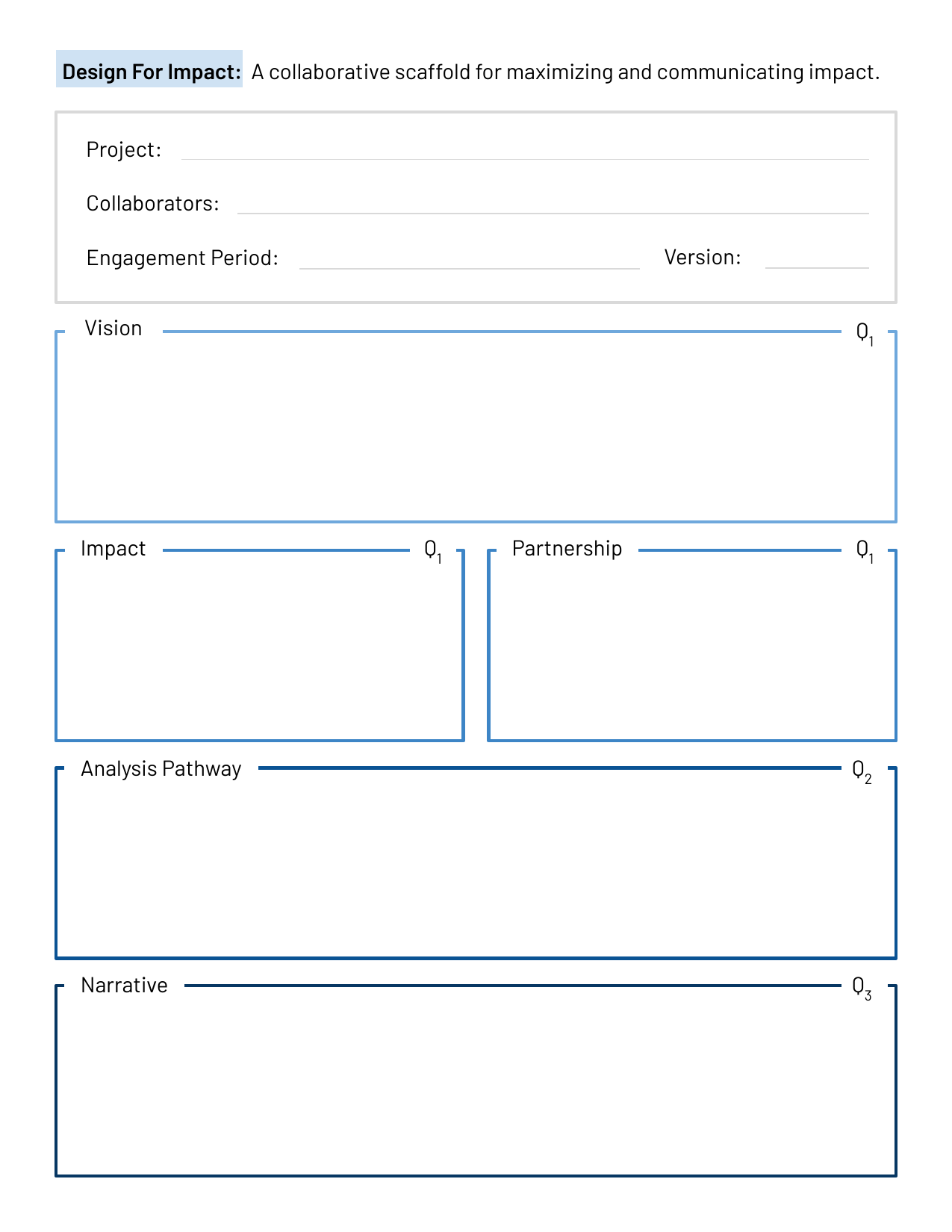
Preview of the blank Design For Impact worksheet, with fields for Vision, Impact, Partnership, Analysis Pathway, and Narrative.

Five components connect purpose, analysis, and action.

Each component supports a different part of the work while keeping the intended impact in view.

Vision — Q1

The long-term goal this collaboration will help advance for the organization or team.

Questions to consider:

  • If this work were exceptionally successful, what contribution would it make to society or the bottom line?
  • What purpose, cause, or belief motivates the project?
  • What long-term outcome will serve as the guiding light?

Impact — Q1

The people this work will serve and the decisions or actions the evidence will enable.

Questions to consider:

  • Who will be affected by this work beyond the immediate collaborators?
  • How will stakeholders use the evidence?
  • Which decisions or actions should the work support?

Partnership — Q1

The expectations and motivations each collaborator brings to a successful working relationship.

Questions to consider:

  • What does each collaborator hope to gain and contribute?
  • What are the expectations for scope and timeline?
  • Are there expectations involving compensation, authorship, or ownership?

Analysis Pathway — Q2

A shared plan for gathering evidence that will enable the intended impact.

Questions to consider:

  • What do stakeholders seek to understand, compare, explain, or predict?
  • Which study design, dataset, model, or visualization best meets those needs?
  • How does the planned analysis connect back to the intended impact?

If the pathway changes substantially, document what was learned in Narrative and begin a new version of the tool. See a four-version example

Narrative — Q3

The concise, evidence-based story of how the analysis contributed to the vision, impact, or partnership.

Questions to consider:

  • What is the key takeaway?
  • Who needs to hear it, and how should it be tailored?
  • How do the findings enable a decision or action?
  • Which direct or indirect stakeholders should be considered?

A scaffold, not a script.

Use the tool as a shared document between you and your collaborator, or adapt it to your needs.

Full Use

Complete and revisit the tool collaboratively throughout the engagement.

Selective Use

Use the components that add the most value for the project at hand.

Mental Model

Use the principles to guide conversations and decisions without filling out the tool.

Throughout the project

Use the tool as a lightweight record of the thinking that connects one phase of collaboration to the next.

  1. Before kickoff

    Review the guide and prepare questions about Vision, Impact, and Partnership. Treat preliminary entries as hypotheses to validate.

  2. During or immediately after kickoff

    Establish Q1 with collaborators and confirm that the artifact reflects a shared understanding.

  3. Before substantive analysis

    Develop an Analysis Pathway connecting the design, data, methods, and communication products to the intended impact.

  4. During analysis

    Use the tool as a pulse-check. Revisit Q1 and Q2 when limitations, findings, or collaborator feedback change the project. Preserve prior versions after substantive changes.

  5. Before closeout

    Draft a Narrative connecting the evidence to the stakeholders, decisions, or actions identified in Q1. Tailor separate Narratives when audiences have different needs.

  6. During and after closeout

    Validate the Narrative with collaborators and incorporate it into presentations, reports, executive summaries, handoff materials, or project records.

Ways to adapt it

Implementation can be as formal or lightweight as an engagement calls for.

  • Asking more vision- and impact-oriented questions during scoping.
  • Incorporating components into an intake form or statement of work.
  • Documenting tried-and-revised Analysis Pathways.
  • Revisiting the tool during standing client check-ins.
  • Drafting a one- or two-sentence impact Narrative before closeout.
  • Using the structure privately in meeting notes when a shared artifact is impractical.

Teaching Design For Impact

Teaching resources include a student pre-read, editable slides, a sample lesson plan, and the current Tool and Implementation Guide.

View Instructional Materials

Plan for impact throughout your next collaboration.

Download the Tool + Guide