Alignment
Establish the project’s broader vision, intended impact, and expectations for the partnership.
Design For Impact
A collaborative scaffold for maximizing and communicating impact in statistical collaboration.
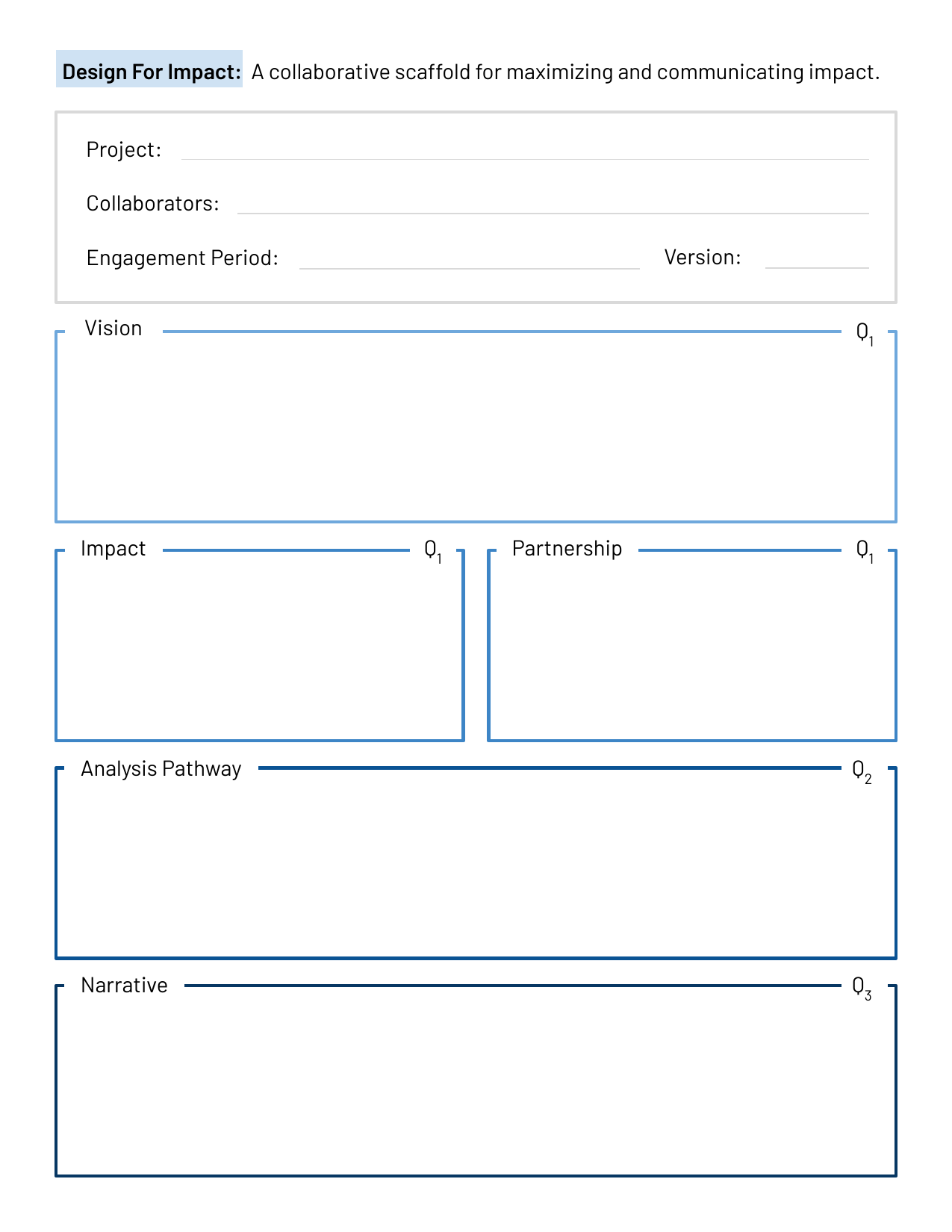
Impact doesn’t happen automatically—it requires alignment, intentionality, and translation.
From evidence to action.
Design For Impact builds on the Q1Q2Q3 framework developed by Vance and colleagues, which moves from qualitative context gathering, through quantitative analysis, to qualitative interpretation.
Q1
Qualitative
Q2
Quantitative
Q3
Qualitative
Establish the project’s broader vision, intended impact, and expectations for the partnership.
Choose the design, dataset, analytical approach, and communication products that enable the intended impact.
Develop an audience-specific, evidence-based narrative connecting the findings to the stakeholders, decisions, or actions identified in Q1.
The tool turns these principles into five practical components.
See Design For Impact in action.
Explore two fictitious collaborations showing how Design For Impact adapts across professional and academic settings.
Connecting customer-segmentation analysis to budget allocation, campaign planning, and conversion.
Using complex findings to guide future research and the design of behavioral interventions.
Resources for applying and teaching Design For Impact.
Integrate Design For Impact into scoping conversations, project check-ins, analysis planning, and closeout without replacing your existing workflow.
Help students connect statistical decisions to collaboration, stakeholder needs, and the communication of evidence.
Design For Impact was refined using feedback from students and practitioners from industry and academia.